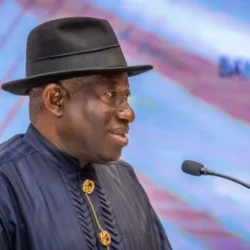


Former President Goodluck Jonathan has called for appointments and leadership recruitment based on competence rather than money, patronage and ethnicity, saying this is central to restoring Nigeria’s battered international image.
Jonathan spoke on Saturday in Abuja while delivering the keynote address, titled “The Brand Nigeria,” at the Paul Alaje Colloquium (TPAC 2026).
He said discussing the national brand was “not an exercise in public relations” but a conversation about national character, leadership and development.
A nation’s brand, he explained, is what the world thinks and says about it, based on its conduct, institutions, achievements and the experiences of its citizens.
The former president identified five developments he said were weakening Nigeria’s reputation: the erosion of values, with wealth celebrated without questions about its source; corruption, abuse of office and impunity; insecurity; the normalisation of cybercrime, drug trafficking and cultism; and the growing preference for money, patronage, ethnicity and personal connections over merit in leadership recruitment and public appointments.
He said these problems undermine investor confidence, weaken international partnerships and reduce the respect attached to the Nigerian name.
Jonathan also pointed to the limited international mobility of the Nigerian passport, saying citizens face considerable visa restrictions. “A passport is more than a travel document,” he said, describing it as a symbol of national identity and of the confidence other countries place in the issuing nation.
He, however, drew a line between the country’s challenges and the character of its people, noting that millions of Nigerians remain honest, industrious, talented and highly respected abroad.
Recalling Nigeria’s past standing, he said the country was once mentioned among emerging economies alongside Brazil and Malaysia, and played leading roles in the struggle against apartheid and in peacekeeping in Liberia and Sierra Leone. He said Afrobeats, Nollywood, football and the work of Nigerian professionals continue to project the country positively. He also referred to the 2009 Rebranding Nigeria initiative, led by the late Professor Dora Akunyili under President Umaru Musa Yar’Adua, with the message “Good People, Great Nation.”
On the way forward, Jonathan said restoring the brand required more than slogans and publicity campaigns. He called for reform of political and leadership recruitment, stronger internal party democracy, more credible elections, and a political culture that rewards ideas, character and competence over money and sectional interests.
Public office, he said, must be treated as a position of trust guided by transparency, accountability and the rule of law.
He urged Nigeria to learn from India, South Korea, Malaysia and Singapore, citing Singapore’s rise under Lee Kuan Yew on the back of meritocracy, integrity and investment in human capital. He cautioned, however, that the lesson was not that Nigeria must become Singapore, but that transformation demands purposeful leadership, institutional discipline and long-term commitment to the public good.
Other recommendations included a secure economy that creates jobs, sustained attention to education, healthcare, agriculture, manufacturing, technology and infrastructure, and stronger support for cultural and sporting industries for diplomacy and economic growth. He also called for a national brand strategy that outlives changes of government and measures progress in restoring international confidence.
Addressing young Nigerians, Jonathan described them as the country’s ambassadors and future leaders. He urged them to demand accountability from leaders while holding themselves accountable as citizens.
“We have not lost our talent, our creativity or our enormous human potential,” he said. “What we must recover are the values, institutions and leadership standards that enable these strengths to flourish.”