

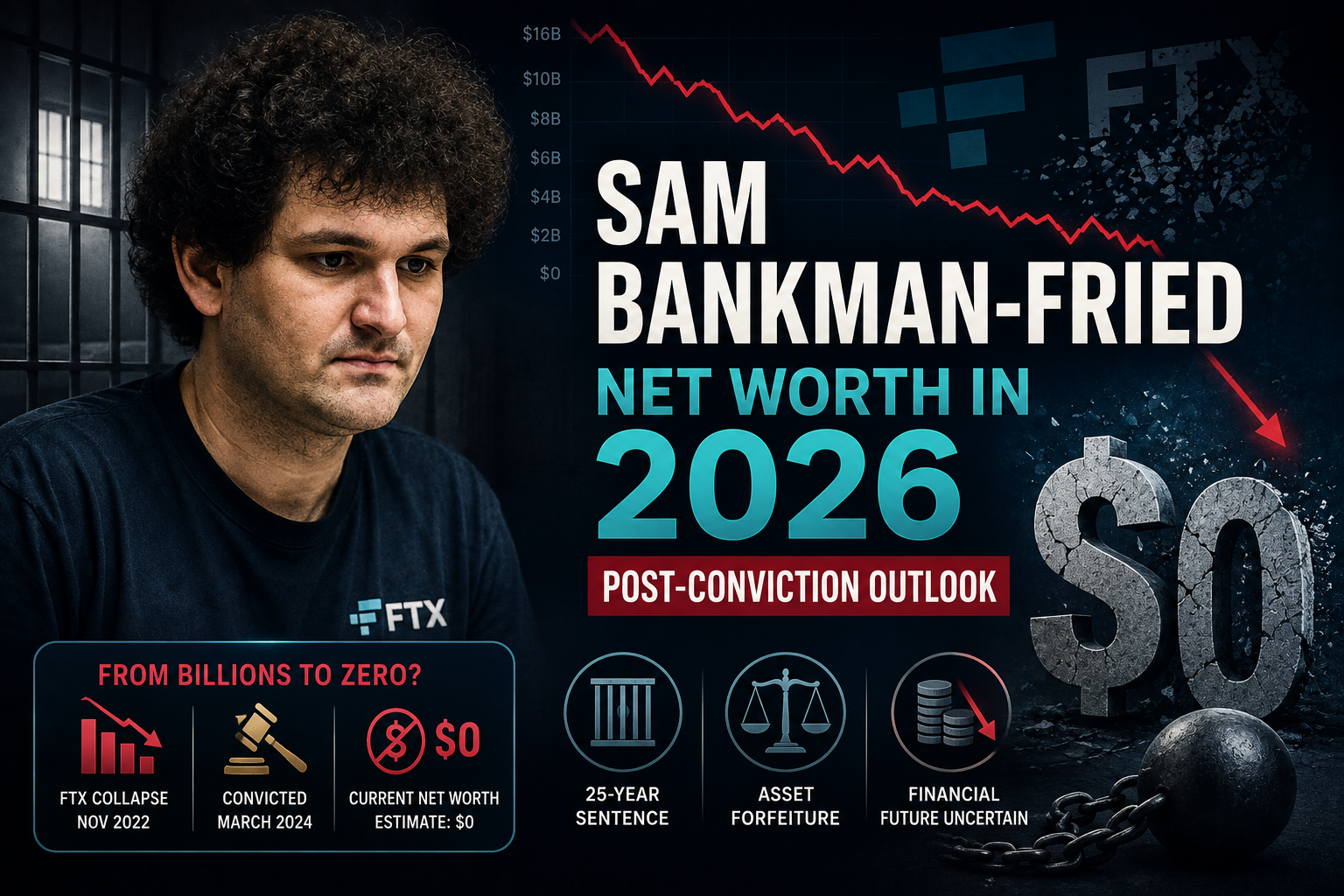
The speculative projection of Sam Bankman-Fried’s net worth in 2026 necessitates a departure from conventional wealth analysis. Given his current legal status—convicted on multiple federal fraud and conspiracy charges—any assessment must pivot from asset accumulation to the profound implications of forfeiture, restitution, and the complete erosion of legitimate earning capacity. The discussion is not one of potential resurgence, but rather a forensic examination of financial decimation and the long-term mechanics of liability.
The Legal Imperative: Forfeiture, Restitution, and Asset Disposition
By 2026, the primary determinant of Bankman-Fried’s financial standing will be the outcome of his sentencing and the subsequent enforcement of judicial orders. His conviction triggers substantial asset forfeiture provisions under federal law, designed to seize proceeds derived from criminal activity. This process is not merely punitive; it’s a mechanism to claw back illicit gains, which in his case are estimated in the billions. The government’s focus will be on identifying, tracing, and liquidating any remaining assets linked to the FTX and Alameda Research fraud, irrespective of their current form or location. This often involves intricate investigations by agencies like the FBI and IRS, working to uncover hidden assets or those transferred to third parties.
Beyond forfeiture, restitution orders will impose a direct, legally mandated obligation to compensate victims for their losses. These orders often carry significant financial weight, potentially extending into the hundreds of millions or even billions, depending on the court’s final determination of victim losses. Unlike fines, restitution is directly payable to victims and remains a persistent liability, often enforceable for decades, even post-incarceration. The process of distributing these funds to victims can be complex and lengthy, often managed through court-appointed administrators.
Furthermore, the ongoing FTX bankruptcy proceedings represent a parallel, yet equally impactful, force. The bankruptcy estate’s efforts to recover and distribute assets to creditors will largely pre-empt any claim Bankman-Fried might conceivably have on residual funds. Any assets not directly seized by the government will likely be absorbed into the bankruptcy estate for creditor distribution, leaving Bankman-Fried with no beneficial interest. The interplay between criminal forfeiture, civil restitution, and bankruptcy creditor claims ensures a comprehensive sweep of any identifiable wealth. For more detailed information on the principles of federal asset forfeiture laws, resources from the U.S. Department of Justice can provide further context.
Deconstructing “Income Sources” in a Post-Conviction Landscape
The notion of “income sources” for Sam Bankman-Fried in 2026 is fundamentally altered by his conviction and impending incarceration. His prior avenues for wealth generation—founding and operating a multi-billion dollar cryptocurrency exchange and hedge fund—are irrevocably closed. While incarcerated, any earning capacity is negligible, typically limited to minimal wages for prison labor. Post-release, the stigma of a federal felony conviction, coupled with massive outstanding financial obligations, will effectively bar him from re-entering any legitimate high-earning professional sphere. The financial services industry, in particular, will likely remain inaccessible due to regulatory restrictions and a complete loss of trust.
The concept of future “earning potential” becomes a theoretical exercise in the face of practical impossibility. Even if he were to attempt to leverage his past notoriety, any earnings would be subject to immediate garnishment for restitution and civil judgments. This creates a perpetual state of financial insolvency, where any legitimate income generated would be diverted to satisfy his immense liabilities, preventing any personal accumulation of wealth. This legal framework ensures that victims are prioritized in any future financial recovery.
The Redefined “Lifestyle” of 2026
Bankman-Fried’s lifestyle in 2026 will be dictated by the penal system, not personal affluence. The transition from a penthouse in the Bahamas and private jet travel to the confines of a federal correctional institution represents the most profound shift imaginable. Post-incarceration, his lifestyle will remain severely constrained by parole conditions, financial obligations, and the practical realities of rebuilding a life with a criminal record and no assets. He will face significant hurdles in housing, employment, and even basic financial transactions, all under the watchful eye of the legal system.
The lavish expenditures on real estate, political donations, and personal luxuries that characterized his pre-collapse existence are not merely gone; they are the very expenditures that form the basis of the forfeiture and restitution claims against him. His future “lifestyle” will be one of austerity, dictated by the necessity of fulfilling legal obligations and the absence of discretionary income, a stark contrast to his former opulence.
The Broader Implications: Precedent and Victim Recovery
The case of Sam Bankman-Fried sets a significant precedent in the realm of financial crime, particularly within the nascent cryptocurrency industry. It underscores the principle that even in rapidly evolving digital markets, traditional laws against fraud and conspiracy remain robustly applicable. This outcome serves as a powerful deterrent, signaling to other potential actors that illicit gains will be pursued and clawed back, regardless of the complexity of the scheme or the digital nature of the assets involved. The global reach of the investigation and prosecution also highlights increasing international cooperation in combating financial misconduct.
For the victims of FTX and Alameda Research, the path to recovery is long and arduous. While forfeiture and restitution orders aim to compensate them, the full extent of their losses may never be entirely recouped. The process involves complex legal battles, asset tracing across multiple jurisdictions, and the liquidation of various types of assets, often at less than their original value. The psychological and financial toll on victims is immense, and while the legal system strives for justice, the practical reality of full financial restoration is often challenging. This case will likely influence future regulatory frameworks and investor protection measures in the digital asset space.
Quantifying the Negative: A Net Worth Dominated by Liabilities
By 2026, Bankman-Fried’s net worth will almost certainly be a substantial negative figure. It will be defined not by assets, but by the aggregate sum of his outstanding restitution orders, potential civil judgments from class-action lawsuits, and any remaining fines. While the exact figure is impossible to predict, it is highly probable to be in the hundreds of millions, if not billions, of dollars in liabilities against effectively zero liquid or illiquid assets. These liabilities are not merely theoretical; they are legally binding obligations that will shadow him for the remainder of his life.
The long-tail nature of these financial obligations means that even decades into the future, any attempt to acquire significant assets or income would be met with legal mechanisms to seize them for victim compensation. Consequently, the strategic analysis of Sam Bankman-Fried’s net worth in 2026 is not about wealth management or growth, but rather the systematic unwinding of a fraudulent empire and the enduring financial consequences for its architect. His financial state will serve as a stark illustration of the profound and irreversible impact of corporate malfeasance. For more insights into current events and financial news, visit ETimes247.