
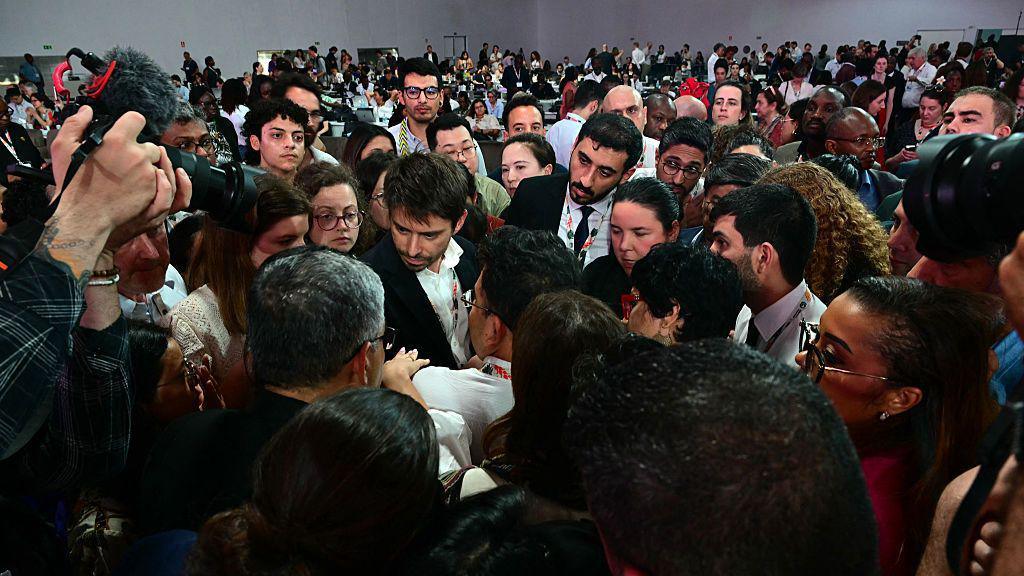
Nearly 200 nations on Saturday pushed through a modest deal at the UN’s COP30 climate summit in the Amazon region of host country Brazil.
It was welcomed by some as a decent outcome amid fraught negotiations — and the absence of the United States — but dismissed as falling short by others.
Here’s a round-up of key reactions:
– Lula –
Brazilian President Luiz Inacio Lula da Silva — who had staked political capital in the success of what he dubbed “the COP of truth” — applauded that “science prevailed” and “multilateralism won” during the talks.
“We mobilized civil society, academia, the private sector, indigenous peoples, and social movements, making COP30 the COP with the second-highest participation in history.”
– Europe –
“We’re not going to hide the fact that we would have preferred to have more, to have more ambition on everything,” EU climate commissioner Wopke Hoekstra told reporters, while saying the deal was still “the right direction.”
French ecological transition minister Monique Barbut was more frank: “I couldn’t call this COP a success,” she said.
But while “this deal won’t raise our overall level of ambition,” she said “it doesn’t disrupt any of the previous momentum” either.
British energy secretary Ed Miliband told AFP “that’s what this COP process is like. You look over the long sweep of history — it had delivered change.”
“Every COP has frustrations.”
– Colombia –
The president of Colombia Gustavo Petro slammed the deal’s lack of plan to phase out fossil fuels, saying Colombia “does not accept” that the declaration “doesn’t say with clarity, as science does, that the cause of the climate crisis is fossil fuels.”
– India, South Africa, Brazil, China –
But India praised the deal as “meaningful.”
“We fully support the (COP30) presidency and recognize the outstanding efforts of the presidency team, including spending many sleepless nights working to ensure that we leave with something meaningful from Belem,” said a representative from India, speaking on behalf of the BASIC coalition of Brazil, South Africa, India, and China.
China meanwhile was “happy with the outcome.”
China’s Vice Minister of Ecology and Environment, Li Gao, told AFP that COP 30 would go down as “success in a very difficult situation.”
– Less-developed countries –
Evans Njewa, who represented a group of 44 less-developed countries, said “we didn’t win on all fronts, but we got tripling adaptation finance by 2035.”
“Thanks for siding with 1.6 billion vulnerable people,” Njewa said of the inhabitants of the African, Asian and island countries he reps. “This was our priority, and we made it a red line.”
And the Alliance of Small Island States called the deal “imperfect” but still a step towards “progress.”
– Guterres –
The head of the United Nations commended the weeks of efforts but said he understood that “many may feel disappointed” with the results, including Indigenous people, youth, and those now feeling the worst impacts of climate change.
“I cannot pretend that COP30 has delivered everything that is needed,” read a statement from Secretary-General Antonio Guterres, who said “the gap between where we are and what science demands remains dangerously wide.”
“I will continue pushing for higher ambition and greater solidarity.”
– NGOs –
The talks also were closely watched by non-governmental organizations working in the climate sector.
The head of the World Resources Institute, Ani Dasgupta, heralded COP30 for delivering “breakthroughs to triple adaptation finance, protect the world’s forests and elevate the voices of Indigenous people like never before
But the formal negotiations fell short in many respects, he said, notably on the lack of a fossil fuel phaseout plan, leading to a “weakened” deal.
Ilan Zugman, Latin American and Caribbean director for the organization 350.org, said that “the lack of concrete commitments in the final text of COP30 shows us who is still benefiting from the delay: the fossil fuel industry and the ultrarich, not those living the climate crisis every day.”