

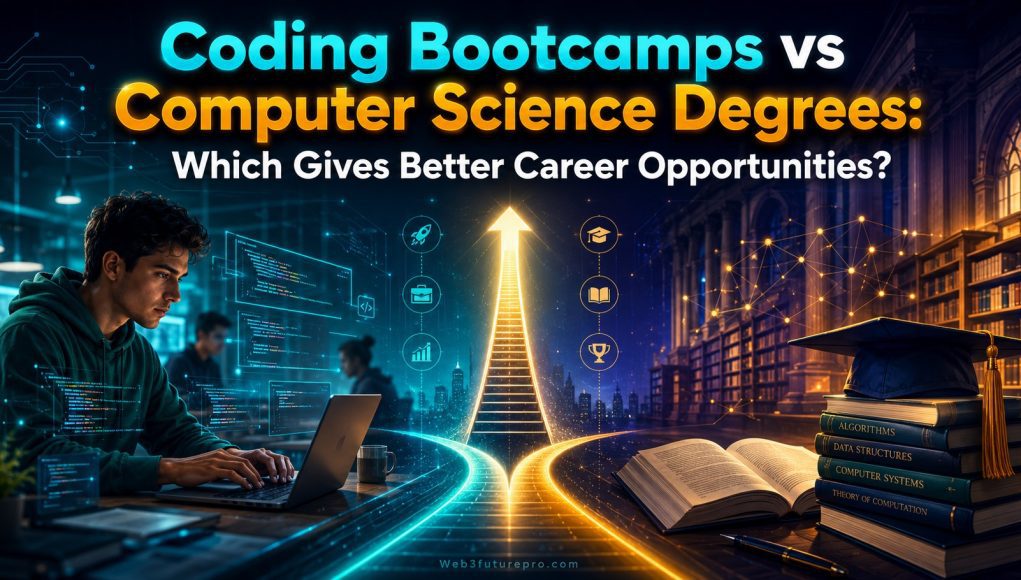
The debate surrounding coding bootcamps versus computer science degrees in the context of career trajectory is often framed as an either/or proposition. However, for experienced professionals navigating the complex landscape of technology careers, a more nuanced, strategic perspective is essential. The “better” option is not absolute but contingent upon individual career aspirations, desired role types, long-term growth potential, and the specific demands of target industries.
The Foundational Depth of a Computer Science Degree
A traditional Computer Science (CS) degree, typically a four-year bachelor’s program, offers a robust theoretical foundation that is unparalleled. Graduates emerge with a deep understanding of core principles, including:
- Algorithm and Data Structure Mastery: Beyond mere implementation, CS programs instill a profound comprehension of algorithmic complexity, efficiency analysis (Big O notation), and the mathematical underpinnings of various data structures. This theoretical rigor is critical for optimizing performance in large-scale systems and solving complex, non-trivial problems.
- Operating Systems, Networking, and Compiler Design: A CS curriculum delves into the architecture of computing systems, network protocols, and the intricacies of how software interacts with hardware. This low-level understanding is invaluable for roles in systems programming, cybersecurity, distributed systems, and high-performance computing.
- Mathematical and Logical Foundations: Discrete mathematics, linear algebra, and calculus form the bedrock for advanced fields such as artificial intelligence, machine learning, computer graphics, cryptography, and scientific computing. Without these mathematical competencies, progression into deep research or highly specialized engineering roles can be significantly hampered.
- Problem-Solving Paradigms: CS education emphasizes abstract thinking, formal logic, and diverse problem-solving methodologies, equipping graduates to tackle novel challenges rather than merely applying existing solutions.
For roles demanding deep theoretical insight, pioneering new technologies, or working within highly regulated or research-intensive environments (e.g., defense, aerospace, advanced AI research, chip design), a CS degree often provides a higher long-term career ceiling and is frequently a prerequisite. It signals to employers a capacity for abstract reasoning and a comprehensive understanding of computing fundamentals that transcends specific toolsets.
The Agility and Market Alignment of Coding Bootcamps
Coding bootcamps, typically intensive programs lasting 3-6 months, are designed for rapid skill acquisition and direct market entry. Their strength lies in their hyper-focused, project-based curricula that align closely with current industry demands. Key advantages include:
- Hyper-Focused, Practical Skills: Bootcamps excel at teaching immediately applicable technologies and frameworks (e.g., specific full-stack technologies, cloud platforms, data science libraries). Graduates are proficient in current industry best practices and can contribute to production environments almost immediately.
- Accelerated Time-to-Market: For individuals seeking a swift career transition or rapid upskilling, bootcamps offer an unparalleled path to job readiness. This accelerated entry into the workforce can translate to earlier earning potential and practical experience accumulation.
- Portfolio-Driven Learning: The project-centric nature of bootcamps ensures graduates build a tangible portfolio of work, which is often more compelling to hiring managers for application development roles than academic transcripts alone.
- Strong Career Services and Networking: Many reputable bootcamps invest heavily in career placement assistance, interview preparation, and fostering industry connections, providing a direct pipeline to entry-level and junior-to-mid-level development roles.
- Adaptability to Market Trends: Bootcamps can rapidly update their curricula to reflect emerging technologies and shifting market demands, offering a nimbleness that traditional academic institutions often lack.
Bootcamps are particularly effective for roles in web development, mobile development, DevOps, quality assurance, and certain data analysis positions where practical proficiency with current tools and frameworks is prioritized over deep theoretical exploration. They provide an excellent “floor” for entering the tech industry.
Strategic Considerations for Career Trajectories
The optimal choice hinges on a strategic assessment of one’s career trajectory:
- Role Specialization:
- Deep Systems/Research: A CS degree is almost indispensable for roles involving operating system development, compiler design, advanced cryptography, or fundamental AI/ML research.
- Application/Web Development: Both pathways can lead to success. A bootcamp provides a faster entry point, while a CS degree might offer a quicker ascent to architect-level roles due to a broader understanding of system design and scalability.
- Data Science/ML Engineering: For roles focused on model deployment and practical application, a bootcamp can suffice. For roles requiring algorithm development, statistical modeling, or foundational research, a CS degree (often with a master’s or Ph.D.) is highly advantageous.
- Industry Sector:
- Established Enterprises/Defense/Finance: These sectors often have stricter credentialing requirements, frequently preferring or even mandating a CS degree for certain engineering positions.
- Startups/Tech-Forward Companies/Agencies: These environments tend to be more meritocratic, valuing demonstrable skills and a strong portfolio over traditional credentials.
- Long-Term Vision and Growth:
- Leadership/Management: While practical experience is key, a CS degree can provide a broader understanding of technical domains, which is beneficial for technical leadership roles that require overseeing diverse engineering teams.
- Entrepreneurship/Product Ownership: The rapid skill acquisition and product-focused nature of bootcamps can be highly valuable for those aiming to build and launch their own products.
- Pivoting and Adaptability: A CS degree provides a robust theoretical framework that allows professionals to adapt to any new technology or paradigm shift, as they understand the underlying principles. Bootcamps equip individuals with the practical muscle to quickly implement new technologies, but may require more effort to grasp entirely new foundational concepts.
The Hybrid Approach and Evolving Landscape
The most powerful strategy often involves a hybrid approach. Many successful professionals combine elements of both:
- CS Degree + Bootcamp for Specialization: A CS graduate might attend a bootcamp to quickly acquire proficiency in a niche technology or framework directly relevant to a new role or project.
- Self-Taught + Bootcamp: Individuals with strong self-study habits might build foundational knowledge independently, then leverage a bootcamp for structured learning, project development, and career services.
- Experience as the Ultimate Equalizer: After 3-5 years of demonstrable experience, a strong portfolio, and a track record of successful projects, the initial educational credential often becomes less critical than proven ability and continuous learning. The industry is increasingly moving towards skills-based hiring, though this shift is not uniform across all companies and roles.
Ultimately, neither coding bootcamps nor computer science degrees inherently offer “better” career opportunities in all contexts. The discerning professional must evaluate their specific career aspirations, financial constraints, learning style, and desired pace of entry. Sustained success in the technology sector is not merely about the initial credential, but about a commitment to lifelong learning, strategic skill development, and the ability to adapt to an ever-evolving technological landscape.